Washing clothes by hand is a task that belongs to an earlier era, and yet a lot of Indian households are still using semi-automatic machines that require moving wet clothes from one tub to another, staying nearby through the wash, and manually managing the rinse cycle. It works, but it takes time you probably do not have.
A fully automatic washing machine changes that entirely. You load the clothes, add detergent, select a programme, and walk away. The machine handles the water intake, the wash, the rinse, and the spin entirely on its own. When it beeps, your clothes are done.
At Rohit Refrigeration, we stock fully automatic washing machines from Bosch, Lloyd, and Panasonic across a range of capacities and load types. This guide is here to help you figure out which one actually suits your home before you buy. We cover the difference between front-load and top-load, how to pick the right capacity for your family size, which features genuinely matter, and what each brand brings to the table at different price points.
What Makes a Washing Machine Fully Automatic
The phrase gets used constantly in appliance marketing, but it is worth being clear about what it actually means and how it is different from the machines that a lot of Indian homes have been using for years.
A semi-automatic washing machine has two separate tubs: one for washing and one for spinning. You fill the wash tub with water manually, run the wash cycle, then transfer the wet clothes by hand to the spin tub, drain it, and repeat for rinsing. The machine does some of the work but requires you to be present and involved throughout.
A fully automatic washing machine is a single tub that handles everything. Water comes in automatically through a connected water supply. The machine measures the load, adjusts the water level to match, runs the wash, rinses multiple times, and spins to remove excess water, all in sequence, all without you doing anything between cycles.
The two types of fully automatic machines are top load and front load, and the difference between them matters more than most buyers realise before they get home and start using one.
Top Load vs Front Load: The Decision That Matters Most
This is the first question to answer because it affects everything else, including the price, the installation requirements, the water consumption, the washing quality, and the day-to-day experience of using the machine.
Top Load Fully Automatic
In a top-load washing machine, you load clothes from the top. There is no door to crouch in front of, and the drum is orientated vertically. Most top loaders use an agitator or an impeller at the bottom of the drum to move the clothes through the water.
Top-load machines are generally cheaper to buy upfront. They are faster; a full cycle typically runs between forty-five minutes and an hour, which is shorter than most front loaders. You can add a forgotten item mid-cycle without stopping the machine entirely, which anyone who has done laundry in a hurry will recognise as genuinely useful. Installation is straightforward, and they work well at standard Indian counter heights.
The trade-off is that top loaders use more water per cycle and are generally harder on fabrics over time. The agitator action is more mechanical than the tumbling action of a front loader, which means clothes experience more friction. For everyday cottons and synthetics, this is fine. For delicate fabrics, the front load tends to be gentler.
The Panasonic NA-F75LR1MRB and NA-F110VD1BB in our range are both fully automatic top loaders. The 7.5kg model suits families of three to four. The 11kg model is designed for larger households or anyone who does fewer, larger washes rather than smaller loads every day.
Front Load Fully Automatic
In a front-load washing machine, the drum is orientated horizontally, and you load clothes from a door at the front. The drum tumbles clothes through a small amount of water at the bottom of the drum repeatedly, which is a gentler and more effective cleaning action than agitation.
Front loaders use significantly less water than top loaders, sometimes 40 to 50% less per cycle, which makes a real difference to your water bill over a year. They are also generally more energy efficient and produce better wash quality on fabrics that need careful handling.
The drawbacks are the price, as front loaders cost more upfront; the cycle time, which is typically ninety minutes to two hours for a full cycle; and the installation requirement. A front loader needs a stable, level surface and proper drainage. You cannot add clothes mid-cycle on most models once the door has sealed and the drum has water in it.
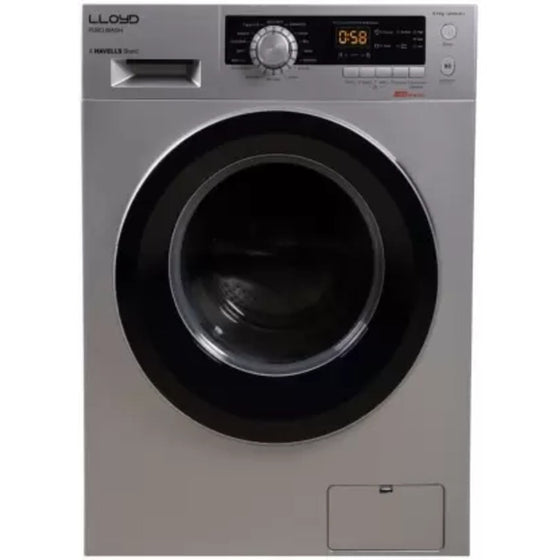
The Bosch WAJ2826BIN and both Lloyd LWMF60SX1 models in our range are front loaders. The Bosch 8 kg with a built-in heater is the premium option in our current range. The Lloyd 6 kg is a practical, well-priced entry point for front-load washing machines.
How to Pick the Right Capacity for Your Family
Capacity in washing machines is measured in kilograms and refers to the weight of dry clothes the machine can handle per cycle. Getting this right is more important than most buyers think about when they are standing in front of the shelf looking at prices.
A machine that is too small for your household means running it twice a day to keep up with laundry, which costs more in electricity and puts more wear on the machine. A machine that is too large for a single person or couple is an unnecessary expense and uses more water and power than the load requires.
Here is a straightforward guide for Indian households.
A 6kg fully automatic washing machine suits a single person or a couple. You can fit roughly two to three sets of bedding, or an average week's worth of clothing for two people, in a single cycle. This is the sweet spot for compact urban households in apartments with limited space.
A 7 to 7.5kg capacity suits a family of three to four comfortably. This is the most popular capacity range in India because it covers the majority of nuclear family households without being oversized.
An 8 to 9kg machine is right for a family of 4 to 5, or for households that do less frequent but larger washes. If you prefer to do one big wash at the weekend rather than smaller loads through the week, an 8kg machine gives you that flexibility.
An 11kg machine is for larger families, joint family setups, or anyone who regularly washes heavy items like blankets, comforters, and multiple sets of bed linen in the same load. The Panasonic NA-F110VD1BB at 11kg is the largest capacity in our current range and is designed for exactly this kind of use.
One thing to keep in mind for front loaders specifically: the actual recommended load for a front loader should not be more than about 80% of its rated capacity. A 6kg front loader works best with around four to five kilograms of clothing. Consistently overfilling a front loader shortens the life of the drum and the bearings.
Features That Make a Real Difference to Daily Use
Washing machine marketing is full of feature names. Some of them describe something genuinely useful. Others are rebadged versions of basic functions with a brand-specific name. Here are the features that actually change how the machine performs day to day.
In-Built Heater
This is the feature that separates a machine that just cleans from one that properly sanitises. An in-built heater allows the machine to heat the wash water to temperatures between 40 and 90 degrees Celsius, depending on the programme selected.
Hot water washing at 60 degrees removes bacteria, dust mites, and allergens that cold water washing simply cannot. For households with young children, anyone with skin allergies, or anyone who wants to properly sanitise bed linen and towels rather than just washing them, a machine with an in-built heater is genuinely better.
Both the Bosch WAJ2826BIN 8kg and the Lloyd LWMF60SX1 6kg in our range come with built-in heaters. This is one of the reasons front loaders dominate the premium segment in India even though they cost more upfront: the heating element is standard on most front-load models and is far less common in top loaders.
Multiple Wash Programmes
A good fully automatic washing machine should have wash programmes that match different fabric types and soil levels. Cotton, synthetics, delicates, quick wash, heavy soil, rinse and spin, and a drum clean programme are the programmes you will actually use. Quick wash is particularly useful for lightly soiled items: most machines with this setting can clean a small load in fifteen to thirty minutes, which is helpful when you need something clean in a hurry.
Spin Speed
Spin speed is measured in revolutions per minute and affects how dry your clothes come out after the cycle. A machine that spins at 1000 to 1400 RPM leaves clothes noticeably drier than one spinning at 700 to 800 RPM, which means less time on the line or on the drying rack.
The Bosch 8kg WAJ2826BIN spins at 1200 RPM. The Lloyd 6kg LWMF60SX1 spins at 1000 RPM. For Indian climates where humidity slows drying, higher spin speed makes a practical difference, especially during the monsoon months.
Delay Start
A delay start timer lets you load the machine, set a programme, and program it to begin at a later time. Practically, this means you can load it before going to bed and set it to run in the early morning so the clothes are done when you wake up, or set it to run during off-peak electricity hours if your tariff has a time-of-use rate.
Child Lock
Useful for any household with small children who might wander over and start pressing buttons mid-cycle. It locks the control panel so the programme cannot be interrupted accidentally.
Why BEE Star Rating Matters for Your Electricity Bill
The Bureau of Energy Efficiency rates washing machines with a star system from one to five. A five-star-rated machine uses significantly less electricity per wash cycle than a 3- or 2-star machine. Over several years of daily use, this adds up to a meaningful difference in your electricity bills.
Front-load fully automatic washing machines are generally more energy efficient than top loaders, which is one of the reasons their running costs over a 4 to 5-year ownership period can offset the higher upfront purchase price. If you are comparing a top load and a front load at similar prices, factor in the long-term electricity cost alongside the sticker price.
For Indian households running the washing machine five to seven times a week, the difference between a three-star and a five-star model in annual electricity consumption can run to several hundred rupees a year, sometimes more in high-tariff states.
Installation and Water Supply: What to Check Before You Buy
A fully automatic washing machine requires a continuous water supply connection, which a semi-automatic machine does not. Before buying, check that the location where you plan to install it has a tap nearby that can supply the machine consistently.
Top-load machines are easier to install in most Indian homes because they do not require a specific counter height or a door-clearance space in front. They work at the height of a standard platform, and the top-loading door can swing open freely even in a compact space.
Front-load machines need a level, solid surface, adequate clearance for the front door to open fully, and a drainage connection at the right height. Many Indian builders now design utility rooms and bathrooms to accommodate front loaders, but in older buildings, this sometimes requires additional plumbing work.
Both types need an earth-connected power outlet. Running a washing machine on an unearthed socket is a safety risk and will also void the manufacturer's warranty on most branded machines.
If you are unsure about installation requirements for your specific home, contact our team before purchase, and we can advise based on your situation.
Common Mistakes Indian Buyers Make When Choosing a Washing Machine
These come up repeatedly, and they are worth knowing about before you make a decision you will live with for the next several years.
Buying based on price alone without checking capacity. A 6kg machine for a family of five will run twice a day and wear out faster than a correctly sized 8 to 9kg machine.
Choosing a top load simply because it is cheaper upfront, without considering the water bill difference. In cities with water scarcity or metered supply, a front loader paying for itself through water savings over three years is a real calculation worth doing.
Ignoring the spin speed. A machine that spins at 700 RPM leaves clothes significantly wetter than one spinning at 1000 to 1200 RPM. In a city apartment without a garden or a rooftop, a slower spin speed means clothes that take much longer to dry indoors.
Not checking the service network before buying a brand. A machine with a poor local service presence is a problem the moment something needs fixing. All the brands in our range have an established service presence in India.
Frequently Asked Questions
What is the difference between a fully automatic and a semi-automatic washing machine?
A fully automatic washing machine connects to your water supply and handles the entire wash process, including water intake, washing, rinsing, and spinning, automatically. A semi-automatic requires you to manually move clothes between the wash and spin tubs and manage the water yourself. Fully automatic machines save time and effort but require a continuous water supply connection.
Which is better for Indian homes: top load or front load fully automatic?
Both work well. Top load suits households that prefer a shorter cycle time, lower upfront cost, and the ability to add clothes mid-wash. Front-load suits households that want better fabric care, lower water and energy consumption, and built-in heating capabilities. Your priorities and budget determine which makes more sense.
What capacity fully automatic washing machine do I need?
As a guide: 6kg for one to two people, 7 to 7.5kg for three to four, 8 to 9kg for four to five, and 11kg for larger families or heavy laundry loads. Do not size down to save money: running a small machine on large loads shortens its life and costs more in electricity over time.
Does an in-built heater make a real difference?
Yes, particularly for sanitising bed linen, towels, and baby clothes. Hot water washing at 60 to 90 degrees removes bacteria and allergens that cold water cannot. If hygiene is a priority in your household, a machine with an in-built heater is worth the difference in price.
How much water does a fully automatic washing machine use?
A top-load fully automatic typically uses 100 to 180 litres per cycle. A front load uses 40 to 80 litres per cycle – significantly less. In cities with metered water supply or irregular municipal supply, this difference affects both your water bill and your ability to run the machine reliably.
Can I use a fully automatic washing machine with low water pressure?
Most fully automatic machines need a minimum water pressure to fill properly. If your water pressure is inconsistent, a top-load machine with an inlet valve that works at lower pressure is sometimes a better fit than a front loader. Check the product specification for the minimum inlet pressure before buying.
How long does a full wash cycle take?
Top-load machines typically complete a cycle in 45 to 60 minutes. Front loaders run longer, usually 90 minutes to two hours for a full wash cycle. Quick wash programmes on both types can complete a lightly soiled load in 15 to 30 minutes.
What is the warranty on the machines you stock?
Warranty terms vary by brand and model. Please check the individual product listing or contact our team for specific warranty details for the model you are considering.